

For Bulk Orders
HARDCOVER
Wiley
256 PAGES
ISBN 9781394407545

The Book
OUTBRAND
15 Essential Marketing Principles to Outthink, Outposition, and Outlast Your Competition.
Organizations reward activity. Markets reward distinction.
A smart team can follow every accepted rule, hit every deadline, and still create work no one remembers. The failure starts before the campaign. It starts with the choices that define whom the brand serves, what it stands for, what it refuses, and why anyone should believe it.
OUTBRAND brings 15 marketing principles together in the order real choices get made. The book draws from decades of research, business thinking, brand successes, costly failures, client work, and classroom debate.
Each chapter starts with a hard choice. It traces the principle to its source, examines the proof behind it, shows a brand that used it, exposes what happened to a brand that ignored it, and ends with questions you can take into your next meeting.
OUTBRAND does not tell you which tactic to run next. It gives you a stronger standard for deciding what deserves to run at all.
Read it alone. Run it with your team. Use it to stop debating from preference and start deciding from principle.
“The best brands stay deeply connected to their customers, culture, and what makes them uniquely themselves. Chris Aarons offers a practical guide to building relevance today and creating enduring brand value over time.”
Tressie Lieberman, Executive Vice President and Global Chief Brand Officer at Starbucks

Available January 12, 2027
Pre-order Outbrand
Preorders include free OUTBRAND companion Workbook for applying the 15 principles.


FREE WORKBOOK
with preorder
OUTBRAND Helps You
THe OUTBRAND MINDSET
Reach the sharper move in the room, instead of defaulting to the obvious one.
Name a position rivals cannot or will not take, and the claims to stop making.
Turn the principles into decision rules your team uses, so meetings end in a call, not more opinions.
Know what to copy, what to refuse to copy, and why.
Build the proof the market actually believes.
In a marketing world constantly disrupted by technology, cultural and social change, and shiny new tactics, OUTBRAND critically reminds us that sustainable marketing-led growth always starts with a powerful consumer insight and a disciplined set of strategic choices that create both differentiation and desire.
OUTBRAND provides a clear and simple playbook to achieve this that connects the steps of the winning process and delivers practical “how-to” guidance at every step.
Rob Malcolm, Executive in Residence, Marketing, McCombs School of Business, and retired Global President, Marketing, Sales, and Innovation, Diageo.
INSIDE THE BOOK
Fifteen principles.
Three sections.
One decision system.
SECTION 1
Outthink
Better strategic choices start with better questions.
01
Where to play and how to win are the core questions your strategy must answer.
CORE Influence: Roger Martin
Strategy is not a list. It is two questions answered specifically: where will you compete and how will you win there. Most strategy documents fail because they answer neither. The principle gives you a test to apply to every plan before it leaves the room.
02
Before any action, ask what a brand worth talking about would do.
ICORE InfluencE: Chris Aarons
This is the filter that eliminates mediocre marketing before it ships. Most brands fail this question every Tuesday. The ones that pass it stop needing better creative briefs and start needing a decision rule the briefs can serve.
03
Customers buy outcomes, not products or features.
CORE Influence: Theodore Levitt
Levitt's insight, restated for an era of feature saturation: people buy the hole, not the drill. The principle reframes the brief, the headline, and the value proposition from inside the product to inside the customer's life.
04
People buy with emotion and justify with logic.
CORE Influence: Zig Ziglar
Many buying decisions begin before people can fully explain them. The data you track often captures the justification, not the choice. The principle changes what you measure and where you intervene in the buying journey.
05
Clone your best customer. Spend where value concentrates.
CORE Influence: Neil Hoyne
Most budgets spread evenly across customers who do not pay evenly. Hoyne's discipline: find the small number of customers driving most of the value, and double down on the patterns that produced them. The rest is overhead.
“Too many people are drowning in data and calling it progress. It isn't. Growth comes from asking better questions, understanding who your customers really are, and building a strategy to reach them. OUTBRAND gets that."
Neil Hoyne, Chief Strategist, Google
Outposition
SECTION 2
Find the behavioral and competitive truths others miss.
06
Pay the price to know your customers and culture.
CORE Influence: Tressie Lieberman
Customer insight is not a survey. It is the discipline of being in the room where customers actually decide, paying attention long after most teams stopped, and changing your mind based on what you find. The cost is real. So is the return.
“Brands grow when they stay curious, listen closely, and stay connected to their customers. OUTBRAND is a thoughtful guide for leaders who want to build meaningful connections, navigate culture with intention, and drive business impact without losing sight of what makes their brand special.”
Tressie Lieberman, EVP, global chief brand officer at Starbucks.
07
Find the moments that matter and show up with what customers need.
CORE Influence: Tressie Lieberman and Rob Malcolm
Brands lose by being everywhere when they should be somewhere specific. The principle finds the small set of moments that decide the relationship and concentrates effort there. Everything else is sponsorship.
08
The simple answer is rarely the best.
CORE Influence: Chris AArons
Simple answers feel right because they confirm what the room already believed. The best answers are usually counterintuitive, partial, and uncomfortable for at least one stakeholder. Notice when the simple answer arrived too quickly.
09
You cannot get different results thinking the same way.
CORE Influence: Rory Sutherland
Most teams diagnose new problems with old assumptions. When results stop moving, the frame is wrong, not the execution. The work begins by questioning what the team has stopped questioning.
10
Not everything that makes sense works. Not everything that works makes sense.
CORE Influence: Rory Sutherland
Marketing rewards the rational and punishes the irrational, even when the irrational is what produces growth. The principle gives leaders permission to act on patterns the data cannot fully explain, and the discipline to test rather than rationalize.
SECTION 3
Outlast
Build trust, relevance, and a durable advantage over time.
11
Context determines how people think, behave, and act.
CORE Influence: Will Leach
The same person makes different choices on a Tuesday morning, a Friday night, and a flight home. Context is not noise around the decision. It is most of the decision. The principle changes how you research, segment, and brief.
“Customers are not fixed personas. Their goals, motivations, emotions, and context change from moment to moment. OUTBRAND is one of the few marketing books that takes that truth seriously and helps you apply it to grow your brand.”
Will Leach, founder & CEO of Mindstates Group and bestselling author of Marketing to Mindstates
12
They ask, you answer. The best way to think about inbound marketing.
CORE Influence: Marcus Sheridan
Customers are typing the questions you should be answering. Build the answers that make you the obvious resource long before the buying decision arrives. Most brands lose this race because they refuse to publish what their salespeople already say.
“Trust is not a marketing claim. It is earned by answering the hard questions, saying what competitors will not, and giving buyers the information they need to decide on their terms. OUTBRAND turns that standard into a practical system.”
Marcus Sheridan, International Keynote Speaker and Bestselling Author of They Ask, You Answer and Endless Customers
13
People need social proof before they buy. Use it everywhere.
CORE Influence: Robert Cialdini
Buyers do not trust your claims. They trust the visible decisions of people who came before them. If proof is not present at the moment of doubt, the moment passes.
14
Email is a privilege, not a right. Earn it.
CORE Influence: Chris AArons
Most lists are subscriber graveyards because brands treated permission as a one-time transaction instead of a renewing trust. Every send either earns the next open or burns it.
15
Create content so useful that people would pay for it.
CORE Influence: Jay Baer
The standard is not good enough to read. It is good enough to charge for. The principle reframes content from marketing output no one asked for into value that earns attention before the relationship begins.
“There are marketing books that make you think, and others that make you money. OUTBRAND is the rare combination of both. It's a sharp guide to cut through the AI slop nonsense and connect with your customers in ways that actually work.”
Jay Baer - NY Times best-selling author of Youtility
The Old Way
- Focuses on chasing trends and algorithm hacks.
- Relies on generic advice that fails in the real world.
- Prioritizes volume over strategic substance.
- Leaves teams guessing which moves actually count.
“Marketing forgot its value came from the people, the relationships. OUTBRAND remembers.”
Neil Hoyne, Chief Strategist, Google
What Makes This Different
THE CONTRAST
The OUTBRAND Way
- Grounded in 15 timeless marketing principles.
- A decision system built for the era of AI-average content.
- Focuses on building trust and long-term relevance.
- Eliminates mediocre marketing before it departs the room.
Who OUTBRAND Is For
Average marketing works by repeating what the competition is already doing.
OUTBRAND works by naming the trade-offs they won’t make.
System1 research shows that 80% of marketing output is a waste of money — not because the creative was bad, but because the strategy was invisible. OUTBRAND is the decision system to fix that.
"AI can generate infinite content. It can't make you memorable.
OUTBRAND is the rare marketing book that gets more useful as the noise gets louder."
Roger Dooley, Author of Brainfluence and The Persuasion Engine
Written for marketers and executives who are tired of settling for the safe or obvious move, this book provides the decision rules to Outthink the room, Outposition the competition, and Outlast the trends.
The answer is not more output.
It is clearer trade-offs.
Read it if
- You need to bridge the gap between abstract strategy and tactical execution.
- You are entering a category where everyone sounds the same and the leader is winning by default.
- You want a system your team can use to kill mediocre ideas before they leave the meeting.
- You value principles that outlast the current quarterly algorithm cycle.
Skip it if
- You are looking for a 'growth hack' or a list of tactical trends to copy.
- You are comfortable with a brand that is safe, invisible, and effectively average.
- You believe that more volume is an adequate substitute for clear strategic choices.
The principles work in B2C and B2B. The question is whether you will use them.
Read a page before you buy.
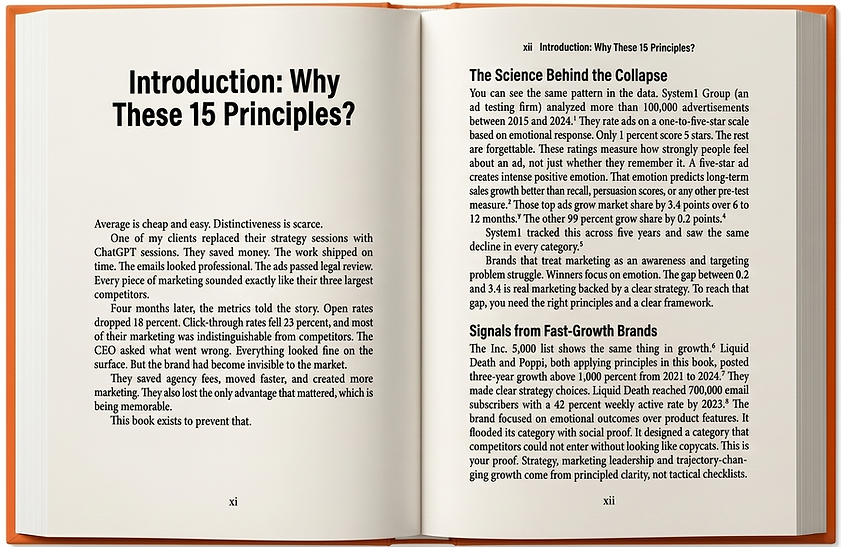
See why the OUTBRAND Principles exist and where they came from.